行业新闻
NEWS
US-based advanced water treatment solutions company VVater has been named as one of Time Magazine’s best climate inventions (2025) for its electro-hydro treatment system. This completes a trio of prestigious awards, following the CES Best of Innovation Award and the World Future Award – the first time any company has won all three in the same year.
总部位于美国的先进水处理解决方案公司VVater,凭借其电-水动力(electro-hydro)处理系统,被《时代》杂志评选为2025年度“最佳气候发明”之一。这是该公司连续斩获三项国际重量级大奖的第三座奖杯,前两项分别为CES最佳创新奖与世界未来大奖——VVater也因此成为首家在同一年同时赢得这三项荣誉的企业。
Aquatech Online spoke to the VVater’s CEO and chairman, Kevin Gast, to learn more about the company’s award-winning innovations, how its core processes work, and to find out why physics may be a better approach to water treatment than chemistry.
Aquatech Online采访了VVater首席执行官兼董事长Kevin Gast,深入了解其屡获殊荣的技术创新、核心工艺的工作原理,以及为何物理方法或许比化学方法更适合水处理。

01
Advanced water treatment based on a simple question
先进水处理技术源于一个简单的问题
VVater’s treatment system is built on two innovations: the Farady Reactor and the ALTEP (advanced low-tension electroporation process) system. But where did the inspiration come from, and how long did it take to bring the company’s ideas to market?
VVater的水处理体系由两项核心创新构成:Farady反应器(Farady Reactor)与ALTEP(低张力高级电穿孔工艺,advanced low-tension electroporation process)系统。但灵感从何而来?公司又用了多长时间将创意带到市场?
“The inspiration came from a simple but powerful question: What if we could treat water using physics instead of chemistry?” explains Gast.
Gast解释道:“我们的灵感来自一个简单却极具力量的问题:如果水能通过物理方式,而不是化学方式来处理,会怎么样?”
“VVater’s engineers drew from advanced electrodynamics, biomedical research on electroporation, and plasma physics to create a process that mimics natural oxidation and reduction but under complete human control and prediction.”
“VVater的工程师从先进电动力学、关于电穿孔的生物医学研究以及等离子体物理学中汲取灵感,创造出一种模拟自然氧化还原反应的工艺,并且完全处于人类可控和可预测的范围之内。”
Originally incubated in a larger conglomerate. VVater became its own entity in 2023. However, development began much earlier.
VVater最初在一家大型企业集团内部孵化,并于2023年独立,然而其技术研发要早得多。
“Development of the Farady Reactor and the ALTEP system began nearly a decade ago, with the first lab-scale prototype built in 2017, pilot testing between 2018 and 2019, and commercial deployment starting in 2019,” adds Gast.
“Farady反应器与ALTEP系统的研发始于近十年前。第一台实验室原型机于2017年建成;试点测试在2018至2019年进行;商用化则从2019年启动。”Gast补充说。
Today, the ALTEP system is used in industrial reuse, municipal treatment, and direct potable reuse (DPR), while the company has also developed other water treatment technologies, such as Advanced Dissolved Flotation Devices (ADAF), and both micro and nano bubble nozzling technologies.
如今,ALTEP已广泛应用于工业回用、市政处理以及直饮水再利用(DPR)领域。同时,公司还开发了多项水处理技术,包括高级溶气浮选装置(ADAF)以及微气泡、纳米气泡喷射技术等。

02
What is a Farady Reactor: what does it do and how does it work?
什么是Farady反应器:运用它做什么?如何工作?
Sitting at the heart of the company’s technology is the Farady Reactor, a next-generation electro-hydro treatment system.
作为VVater技术体系的核心,Farady反应器是一款新一代“电-水动力”处理装置。
Gast explains how it works: “It uses controlled electric fields and harmonic energy to purify water without chemicals, filters, or membranes. Instead of forcing water through barriers like reverse osmosis or adding oxidants, the Farady Reactor uses carefully tuned electrical waveforms to activate natural reactions already present in water, splitting molecules, neutralising contaminants, and sterilising microbes, all in a single pass.”
Gast解释其工作原理:“它利用可控电场与谐波能量,无需使用化学品、滤材或膜组件即可完成水处理。Farady反应器并不依靠反渗透式的压力过滤,也无需投加氧化剂,而是通过精确调谐的电波形激活水中原本就存在的自然反应,裂解分子、消除污染物并灭杀微生物——所有过程都可在一次处理循环中完成。”
Deployed as a compact, modular system, the Farady Reactor can be used to treat a wide range of source waters, from small community supplies to industrial or municipal flows.
作为一种紧凑、模块化系统,Farady反应器适用于多种水源,从小型社区供水到工业与市政水流均可部署。
03
What is an advanced low-tension electroporation process?
什么是低张力高级电穿孔工艺?
Within the Farady Reactor, VVater’s Advanced Low-Tension Electroporation Process (ALTEP) provides proprietary field-control. But what does this mean?
在Farady反应器内部,VVater的ALTEP系统承担专有的电场控制功能。然而,它究竟意味着什么?
“Traditional electroporation uses high-voltage electrical pulses to disrupt cell membranes in biology labs,” begins Gast. “VVater re-engineered that concept for water treatment using a low-voltage alternating current, creating oscillating microelectric fields that destabilise microbes, breaking molecular bonds, in real time.”
Gast解释道:“传统的电穿孔通常使用高压脉冲电场,在生物实验室中破坏细胞膜。VVater重新设计了这一概念,采用低电压交流电,形成振荡微电场,从而实时破坏微生物、解离分子键。”
With no moving parts, no filter media, and no membranes, the system resembles a stainless-steel reactor and is delivered as a plug-and-play module that integrates directly into existing treatment systems.
整个系统无任何移动部件、无滤料、无膜组件,主体外观类似不锈钢反应器,能够以可直接接入现有处理流程的“即插即用(plug-and-play)”模块方式交付。
04
How does the system destroy contaminants, such as PFAS?
VVater如何消除包括PFAS在内的污染物?
One of the biggest challenges facing water companies is how to effectively ‘treat’ contaminants and pollutants, such as pharmaceuticals and per- and polyfluoroalkyl (PFAS) substances, whether that involves simply capturing them or destroying them entirely.
当今供水机构面临的最大挑战之一,是如何有效处理诸如药物残留以及全氟和多氟烷基物质(PFAS)等污染物,包括如何实现从单纯的“捕获”到真正的“破坏”。
Gast explains how the reactor breaks down PFAS: “Inside the Farady Reactor, alternating electrical fields in different chambers and cassettes create two reactions: oxidation and reduction.
Gast解释了反应器如何分解PFAS:“在Farady Reactor内部,不同腔室与组件中交替变化的电场会引发两类反应。”
During the oxidative phase, highly reactive oxygen species (like hydroxyl radicals) are generated, which attack organic pollutants such as pharmaceuticals and microplastics.”
“氧化反应与还原反应。氧化阶段会产生高活性的含氧自由基(如羟基自由基),用以攻击药物残留、微塑料等有机污染物。”
He adds: “During the alternating phases, hydrated electrons and atomic hydrogen break apart ultra-strong chemical bonds, including the carbon-fluorine bonds found in PFAS, effectively defluorinating these forever chemicals into harmless fluoride ions and smaller carbon fragments.”
他进一步补充:“在交替的反应阶段,水合电子与原子氢会破坏超强化学键,包括PFAS中的碳–氟键,从而将这些‘永久化学物’有效裂解为无害的氟离子与更小的碳基碎片。”
05
What waste is left over once contaminants are destroyed?
污染物被破坏后会留下什么废物?
According to the company’s website, the system generates no waste, so what happens to the broken-down contaminants?
根据公司官网的说明,该系统几乎不产生废物。那么被分解的污染物最终去了哪里?
“In conventional systems, contaminants are concentrated and disposed of elsewhere. In VVater’s process, contaminants are chemically converted, not just moved, depending on feedstock water quality,” Gast explains. “For example, in sewerage wastewater, VVater averages roughly two per cent of waste, meaning above 98 per cent recovery.”
Gast解释:“传统工艺会将污染物浓缩再移至其他地点处置;而VVater的处理过程不是‘转移’,而是‘化学转换’,具体取决于进水水质。例如,在污水处理应用中,VVater平均仅产生约2%的废弃物,回收率高于98%。”
He adds: “Organic compounds are oxidised into simple gases such as carbon dioxide and nitrogen, or reduced into stable mineral salts. Some heavy metals are electro-precipitated and easily collected in solid form for safe disposal or recycling.”
Gast表示:“有机化合物会在氧化作用下转化为二氧化碳、氮气等简单气体,或在还原作用下变成稳定的无机盐类。一些重金属会在电化学作用下沉积成固态,便于安全收集与回收利用。”
06
How does the system compare reverse osmosis?
与反渗透相比,系统效果如何?
Reverse osmosis (RO) works by forcing water through membranes at high pressure, which consumes large amounts of energy and produces concentrated brine waste.
反渗透(RO)需以高压将水强行透过膜来运行,能耗高,且会产生高浓度盐水废液。
The Farady Reactor operates with no pressure and no membranes, relying instead on low-voltage electrical energy, which uses roughly one-tenth of the energy used by typical RO systems.
Farady反应器无需加压,也不依赖任何膜组件,而是以低电压电能驱动处理过程,其能耗大约为典型RO系统的十分之一。
“Efficiency has been confirmed through controlled lab studies and field-scale validation using industry-standard ASTM and EPA analytical methods, demonstrating equivalent or superior contaminant removal with drastically lower energy input and zero waste byproduct,” explains Gast.
Gast指出:“通过采用ASTM和EPA行业标准的分析方法进行的实验室验证及实际应用验证,我们已确认该系统在能耗大幅降低且无废液副产物的情况下,可实现与反渗透相当甚至更优的污染物去除效果。”
So far, VVater has treated over 4.3 billion gallons, in addition to more than 8000-plus lab tests carried out across the globe.
迄今为止,VVater已处理超过43亿加仑的水,并在全球范围内开展了8000余次实验室测试。
07
A versatile solution for different water challenges
多场景适用的高适配性解决方案
VVater is first and foremost an engineering company that is to a degree technological agnostic and it’s systems can be used in a wide variety of scenarios, as Gast explains:
“The core physics and chemistry of the Farady Reactors are similar in different applications. At residential scale, the Shield™ system uses smaller Farady Reactors for point-of-entry treatment, with an AC/DC water softening module and purifying household water without filters or salt. At industrial and municipal scales, the same technology scales linearly by adding multiple reactors in sequence, maintaining the same energy efficiency and treatment profile.”
VVater本质上是一家工程公司,在技术路径上保持相对中立,其系统可应用于多种复杂场景。正如Gast所述:“无论应用场景如何,Farady反应器的核心物理与化学机制保持一致。在居民用水处理方面,Shield™系统使用小型Farady反应器作为入户端设备,并搭配交流/直流水质软化模块,使家庭用户实现无滤芯、无盐软化及净化处理。在工业与市政规模下,同一技术则可通过串联多个反应器实现线性扩展,同时保持相同的能效与处理特性。”
There are, however, some limitations: “We realise that our Advanced Oxidation Process or Advanced Reduction Process technologies will not work everywhere. As such, our objective is to solve the customer’s problem even if that means using conventional or traditional technologies adjacent to ours.”
但该技术也并非在所有情况下都适用:“我们充分认识到,先进氧化与先进还原技术并不能应对全部工况。因此,我们的目标始终是解决客户的问题,即便这意味着我们需要将传统工艺与自有技术并行部署。”
It is not a desalination technology, and there are limitations around solids with large particulate sizes. To overcome such challenges, the Farady Reactors can be used in a treatment train with other technologies to handle a wide variety of influent conditions, from secondary treatment onwards to industrial applications treating water to an exceptionally high quality.
此外,这并不是一项海水淡化技术,在处理含大粒径固体的水源时存在一定局限。为克服这些情况,Farady反应器可与其他处理技术组成处理链路,从二级出水一直到高要求的工业处理水质,均可满足不同进水条件的需求。
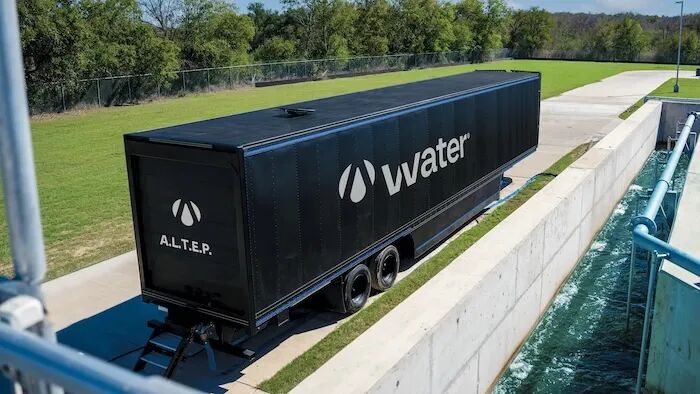
However, it is essentially the same design that powers the home-based Shield system that is used in the ALPHA™ Mobile Water Treatment System, which is a trailer-based unit capable of treating up to 100,000 gallons per day for disaster relief, remote sites, or for temporary industrial needs.
值得注意的是,家用Shield系统所依托的设计,与用于ALPHA™移动式水处理系统的技术本质一致。后者为拖车式装置,可用于灾害救援、偏远地区或临时工业需求,每日处理量可达10万加仑。
08
What is the next stage of development for the technology?
该项技术的下一阶段发展方向是什么?
Gast sees the electrification of water treatment as having a very bright future.
在Gast看来,水处理的电气化有着极为广阔的前景。
“The technology currently outperforms a fast array of solutions in the market however our technology is still in its infancy stages and our objective is to further refine, understand and micronize our technology,” he says.
他表示:“尽管这项技术目前已优于市场上多种解决方案,但它仍处于发展的早期阶段,我们的目标是进一步精炼、深化理解并实现微尺度化。”
“We realise there are infinite possibilities from residential markets and home pool systems to military applications. We have been systematically approaching specific verticals and challenges where we can make the most impact and solve water shortage problems.”
他指出:“从住宅市场与家庭泳池系统到军事应用,潜在场景几乎无限。我们正以系统化方式瞄准特定垂直领域与关键挑战,在能够产生最大影响的地方介入,以解决全球水资源短缺问题。”
One of those challenges will be to tackle the complex chemistry of destroying PFAS in commercial settings. Another goal is to further develop the company’s Redstar AI system that will use “vast amounts of in-line sensors” to detect and understand fluctuations with influent so that it effect real-time changes/tweaks to a treatment system to ensure a constant quality output.
其中之一便是在商业场景中进一步攻克PFAS破坏过程背后的复杂化学机制。另一个研发重点是持续推进公司的“Redstar AI系统”,该系统将利用“海量在线传感器”监测并了解进水条件的波动,从而实时调节处理过程,确保出水水质始终保持稳定。
荷兰阿姆斯特丹国际水处理展览会·中国展暨Aquatech China 2026亚洲水技术展览会将于10月28-30日在上海新国际博览中心盛大举办。作为专注于水、服务于水的水处理行业风向标展览会,Aquatech China参展品牌及展品覆盖水处理全产业链,包含净水、水与污水处理、水环境治理、给排水管网及泵管阀、过程控制与自动化管理、智慧水务等领域。展会背靠荷兰母展近60年水处理展会经验与资源,辐射亚太地区水处理行业,是全球水处理人技术交流、商贸往来的优选专业平台。